YouTube Is Not ‘Social’ Media Anymore (And It Never Really Was)

YouTube Is Not ‘Social’ Media Anymore (And It Never Really Was)
There is a stat that keeps coming up in conversations I have with brand marketing teams. A Pew Research Centre survey from June 2025, covering over 5,000 US adults, found that 84% of them use YouTube. That is more than Facebook at 71%, more than Instagram at 50%, and more than double TikTok at 37%.
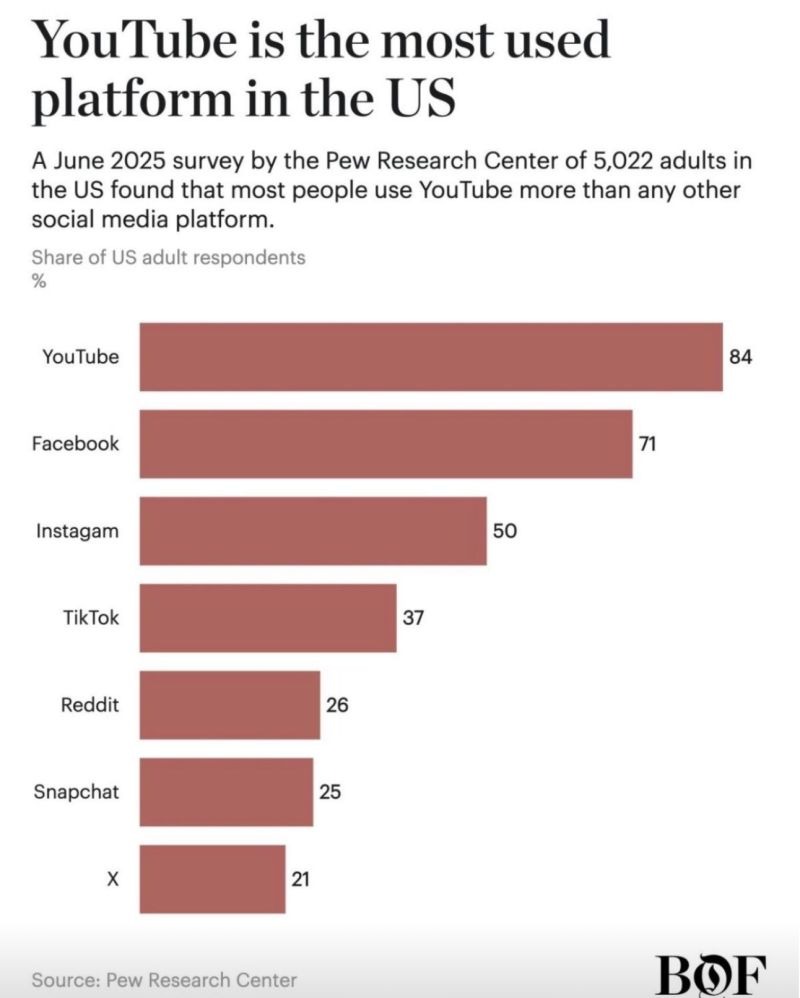
On the surface, that looks like a social media ranking. YouTube wins, everyone else loses, interesting enough. But the ranking is not what I keep thinking about. It is what the ranking actually reveals.
YouTube Stopped Being Social Media A Long Time Ago
Here is the thing. The moment you slot YouTube into the same category as TikTok or Instagram, you have already misunderstood what it is.
Social media is where you scroll, react, and move on. It is short bursts. It is designed around what your friends are doing, what is trending right now, what gets the dopamine hit in under thirty seconds.
YouTube is none of those things. Or rather, it is all of those things and a hundred others on top.
Think about what actually happens on YouTube on any given day. Someone watches a ten part documentary series on the history of Formula 1. Someone else searches how to fix their boiler. A student sits through a two hour lecture on macroeconomics. A family puts on a nature series from BBC Earth while they cook dinner. A professional watches a product review before making a £3,000 purchasing decision. A teenager discovers a band through a live concert upload.
That is not social media behaviour. That is just media behaviour. Full stop.
YouTube is search. It is education. It is breaking news. It is long form entertainment. It is podcasts. It is live events. It is on your television, not just your phone.
And the second you call it social media, you mentally box it in. You start treating it like a place to post clips and rack up likes. You stop treating it like what it actually is: an entirely parallel media universe, sitting inside a single platform.
The Oldest Media Institution In The World Just Told You Something
There is a signal that I think brands have not fully processed yet.
The BBC, which has been around since 1927, recently restructured to go YouTube-first. Not TV-first. Not streaming-first. YouTube-first.
That is not a digital experiment. That is not a marketing team trying something new. That is a 100 year old institution looking at where attention lives and reorganising around it.
When an institution that old changes direction, it is worth pausing and asking why.
The BBC has 101 channels on YouTube. 175 million subscribers. 48 billion views. Their shows get more viewership from YouTube uploads than from their original TV broadcasts, because there is no waiting for a prime time slot. The content is available to an engaged audience, twenty four hours a day, seven days a week.
BBC Earth, BBC News, BBC Music. Each channel laser focused on its own audience. Each one compounding in value every single week regardless of what is happening in traditional television.
That is not a company maintaining a social media presence. That is a company rebuilding its entire distribution model.
Attention Is The New Currency. YouTube Owns It.
We are living through what I genuinely believe is the slow, unspectacular, incredibly important death of traditional media. Not a dramatic collapse. Not a single moment. Just a steady migration of attention toward a platform that gives people exactly what they want, when they want it, on whatever screen they happen to be looking at.
Red Bull did not buy a Super Bowl ad to build their brand. They built 24 billion views worth of content that people actively chose to watch. Formula 1's YouTube channel now pulls more views than their actual television broadcasts. The Oscars will stream exclusively on YouTube in 2029.
These are not random data points. They are a pattern. And the pattern is pointing in one direction.
Brands that own attention are slowly replacing brands that rent it.
Renting attention looks like this: you pay for a media slot, your message appears in front of people who did not ask for it, the money disappears the moment you stop paying, and the effectiveness of each pound you spend quietly erodes every quarter.
Owning attention looks like this: you create something worth watching, the algorithm connects it to the right people, those people come back for more, and the asset you built continues working for you for months or years after you made it.
YouTube is not the only place you can own attention. But it is the most powerful. Because it has scale across every age group, every interest, every platform, every device, and it has the search intent of Google and the entertainment pull of Netflix wrapped into one.
What This Actually Means For Brands
Here is the honest question underneath all of this data.
If 84% of adults are on YouTube, and the BBC is restructuring around it, and the platform is the primary place people go for search, education, entertainment, and news, why are so many brands still treating it as a secondary channel?
I think the answer is that YouTube feels harder. A social post takes an afternoon. A YouTube strategy takes a genuine commitment to storytelling, consistency, and thinking about your audience as people who need a reason to click, not just a brand message pushed in their direction.
But harder is not the same as not worth it. In most cases, it is the opposite.
The brands that are moving on YouTube right now are building something that compounds. Every video is a digital asset. It does not expire after 48 hours the way an Instagram post does. A well made YouTube video can bring in views, leads, and trust for years.
The brands that wait are not saving time. They are just falling further behind.
The Question Worth Sitting With
YouTube being the most used platform in the US is interesting. But the more important question is what that usage actually looks like.
People are not just scrolling YouTube. They are spending time there. Real, sustained, intentional time. They are learning on it. Being entertained on it. Making purchasing decisions because of it. Building parasocial relationships with brands and creators through it.
That is a fundamentally different kind of attention than a quick scroll on Instagram. And it deserves a fundamentally different kind of strategy.
The brands that understand that difference are the ones who will look back in five years and feel very glad they moved when they did.
The ones who do not will just wonder where their audience went.



.png)
.jpg)