How to Choose a YouTube Production Company (Brand Guide)

How to Choose a YouTube Production Company (Brand Guide)
Here's an uncomfortable truth: you can spend £100,000 on video production and still get 2,000 views.
I've seen it happen. Repeatedly. A brand hires a beautiful production company — cinematic shots, colour-graded to perfection, the kind of thing that wins awards at industry nights — and then... nothing. The algorithm ignores it. Viewers scroll past. The campaign quietly dies.
Over the last decade, I've built a YouTube channel with 1.5 million subscribers and 350 million views. I've worked with brands like BBC, Formula E, UEFA, Sony, and National Geographic. And the single biggest mistake I see brands make — consistently, almost ritualistically — is choosing their YouTube partner based on production quality.
That's the wrong metric. Full stop.
This guide is going to tell you what to actually look for — and give you the questions to ask before you sign anything.
YouTube Is Not What Most Brands Think It Is
Before we get into the criteria, let's sort out a foundational misunderstanding. Most brands treat YouTube like a fancier version of their other content channels — somewhere to upload brand films, product launches, and polished corporate videos.
That framing is the source of most YouTube failures.
YouTube is three things simultaneously: a search engine, a recommendation engine, and a storytelling platform. When someone opens YouTube, they're not looking for your brand. They're looking for something that satisfies a curiosity, solves a problem, or entertains them for the next 15 minutes. Your video has to compete for that attention — not just against other brands, but against MrBeast, the BBC, Red Bull's media empire, and a 19-year-old in his bedroom who's really good at making people click.
Red Bull understood this early. They didn't approach YouTube like an ad platform — they built a media company. Today, their channel has 24 billion views. If they'd bought that reach through traditional advertising, it would have cost over £500 million. Instead, they created content people genuinely chose to watch.
The brands that win on YouTube aren't the ones with the biggest production budgets. They're the ones that understand the platform. And that starts with who you hire.
The 6 Criteria for Choosing the Right YouTube Partner
Not all YouTube production companies are built the same. Some are excellent filmmakers. Some are social media agencies that have added 'YouTube' to their service list. Very few are genuinely strategy-led partners who understand what actually drives views, watch time, and growth.
Here's how to tell the difference.
1. Do They Actually Understand YouTube Strategy?
This sounds obvious, but it's genuinely rare. Most video production companies understand filmmaking. They know lenses, lighting, colour grading, and editing rhythm. What they often don't understand is click-through rate (CTR), average view duration (AVD), retention curves, and the mechanics of how the YouTube algorithm distributes content.
Ask them: What CTR do you target on thumbnails? What's an acceptable watch time percentage for a 20-minute video? How do you think about the first 30 seconds of a video in terms of retention?
If they look blank, or pivot to talking about visuals, that tells you everything. You're not hiring a cinematographer. You're hiring a growth partner. The two are very different jobs.
2. Do They Lead with Ideas, or Just Execution?
Here's a question worth sitting with: when you brief a potential YouTube partner, who's bringing the ideas?
The right partner doesn't just take your brief and execute it. They interrogate it. They challenge the premise. They bring you video concepts that are grounded in what the platform's audience actually clicks on — not what looks good in a deck.
At Owen Creative, I always say the order of operations matters enormously:
Ideas → Titles → Thumbnails → THEN production.
Most agencies reverse this. They start with what they want to film, and bolt on the packaging at the end. But if the concept isn't right — if the title doesn't spark curiosity, if the thumbnail doesn't stop the scroll — no amount of beautiful production will save it.
3. Do They Take Titles and Thumbnails Seriously?
This is where most brands — and most agencies — have a genuine blind spot.
Titles and thumbnails are not afterthoughts. They are the product. They are the thing that determines whether your video gets watched at all. I aim for a 5.5%+ CTR on thumbnails — and if a video dips below that threshold in its first few weeks, we swap the packaging out and test something new.
Nike's YouTube presence is a perfect example of this in reverse. Their production is stunning. Truly world-class. But a lot of their content fails to generate meaningful views because the packaging communicates nothing. There's no curiosity. No reason to click. It looks like brand advertising, and YouTube's audience ignores brand advertising.
Ask your potential partner: who owns titles and thumbnails in your process? Is it an afterthought, or is it central to how you develop concepts?
4. Can They Show You Real Results?
Showreels are lovely. But views are the scoreboard of YouTube.
When evaluating a YouTube agency or production company, push past the cinematic B-roll and ask for the numbers. Views. Watch time. Subscriber growth. CTR. Before-and-after results on channels they've worked on. If they can't show you these — or if they deflect with language about 'brand awareness' and 'engagement' — you have your answer.
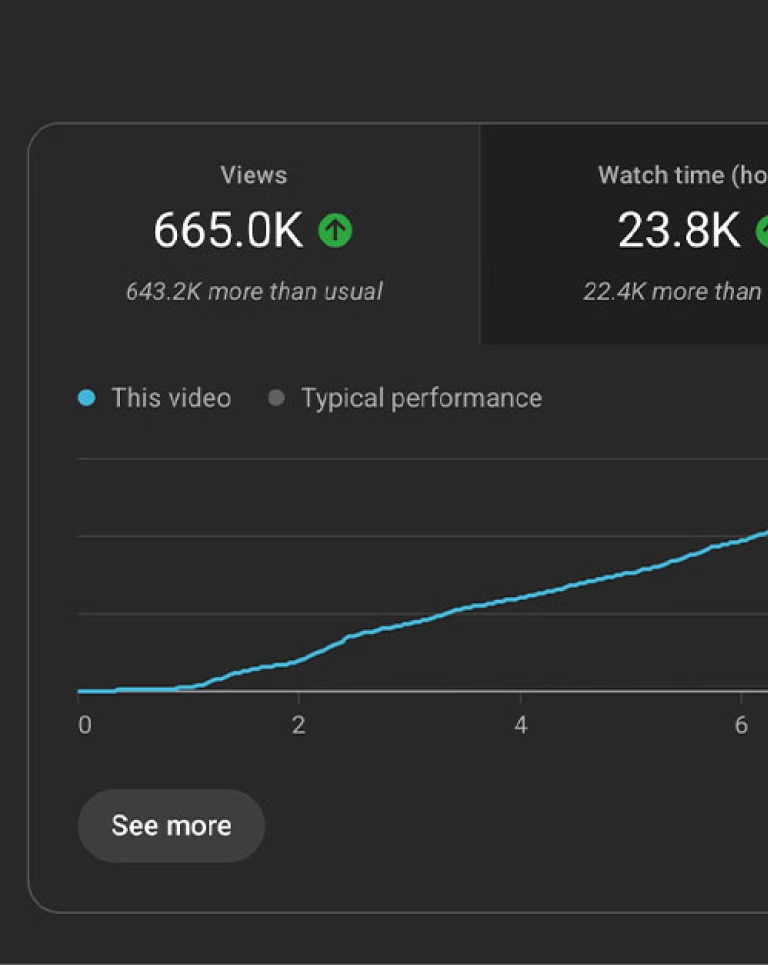
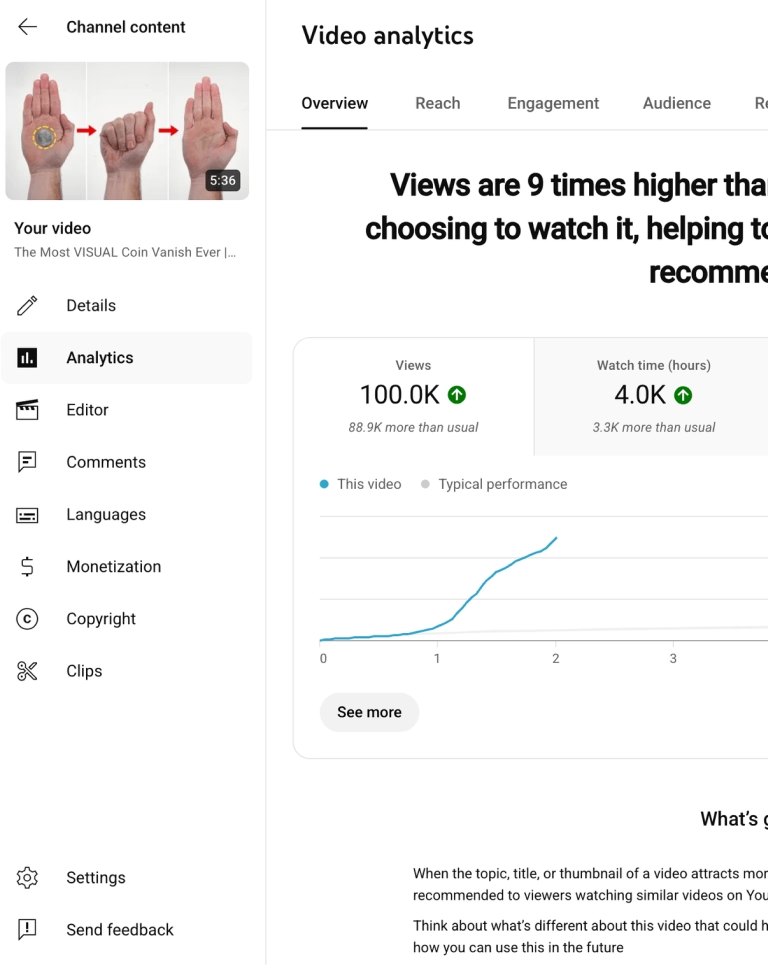
For context, here's what real results can look like: we helped a client generate 14 million views on a single video and £25,000 in YouTube ad revenue. Another client hit 200,000 views in 16 days — and couldn't handle the volume of inbound leads that followed. A separate engagement produced 32 million views for Formula E. These aren't flukes. They're the output of a strategy-led process.
There's a lot of YouTube advice out there from people who've never hit a million views, let alone ten million. Be sceptical of credentials you can't verify.
5. Do They Build Systems, or Just Deliver Videos?
This might be the most important distinction of all.
YouTube doesn't reward one-off content. It rewards consistency. The algorithm is designed to surface channels that publish regularly, build audience habits, and develop recognisable formats. A single great video is a nice result. A library of well-packaged, consistently excellent videos is a growth engine.
Look at the BBC's approach. They don't have one YouTube channel — they have 101. BBC News, BBC Earth, BBC Music, each one laser-focused on a specific audience. The strategy is deliberate: build multiple format systems that connect specific content to specific people, and let the algorithm do its job. Red Bull has done the same thing with verticals across motorsport, cycling, snow sports, and more.
The question to ask: are they building you a content system, or delivering a video? The former compounds. The latter doesn't.
6. Can They Scale With You?
Assuming everything else checks out, the final question is operational: can they handle volume?
A serious YouTube strategy for a brand requires consistent long-form output, a short-form discovery engine that feeds into it, and the capacity to test, iterate, and optimise. That's not a one-person freelance operation. You need a partner with systems — for production, for packaging, for distribution.
Ask whether they can work across formats. Whether they have production workflows that allow for regular output without sacrificing quality. Whether they've scaled operations before, or whether they're figuring it out as they go.
The Big Reframe: You're Not Looking for a Production Company
Here's where I want to challenge the premise of the search you're probably doing.
The best YouTube partners aren't production companies. They're strategy-led content partners. There's a meaningful gap between the two:
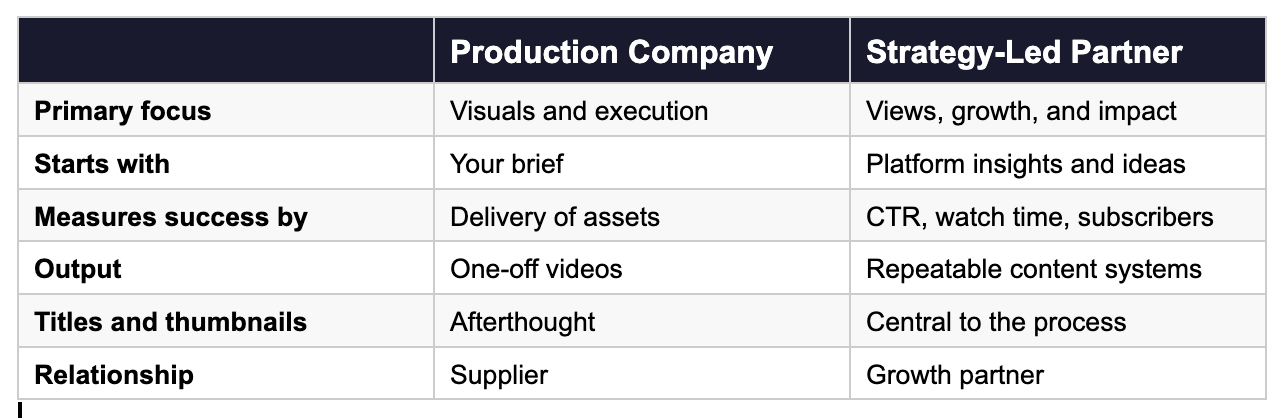
Production-only agencies look good in meetings. Strategy-led partners make you look good on YouTube. Those are very different outcomes.
The Most Common Mistakes Brands Make
I'll be direct here, because I've watched too many good brands waste serious budget on the wrong things.
- Choosing based on showreel. A beautiful reel tells you someone can film. It tells you nothing about whether they can grow a channel.
- Overvaluing cinematic quality. High production value doesn't drive clicks. Titles and thumbnails do.
- Treating YouTube like advertising. YouTube is a storytelling platform. Content that feels like an ad gets ignored like an ad.
- Ignoring packaging. The best video in the world loses if nobody clicks it. Titles and thumbnails are not optional extras.
- Producing one-off content. A single video is not a YouTube strategy. Consistency and format systems are.
- Not committing long-term. YouTube is compounding. The brands that win are the ones who treat it like a long-term investment, not a campaign.
Before You Hire Anyone: Your Buyer Checklist
Use this in every conversation with a potential YouTube production partner. The answers will tell you more than any showreel.
- How do you come up with video ideas?
- Who is responsible for titles and thumbnails in your process?
- Can you show us examples of videos that performed well — with view counts?
- What's your approach to growing a channel over 12 months?
- How do you measure success? What KPIs matter to you?
- Do you build repeatable content formats, or do you approach each video independently?
- What's your process for testing and iterating when a video underperforms?
If they can't answer these clearly and confidently, they are not a YouTube strategy partner. They're a production company that wants a YouTube client.
The Real Question to Ask Yourself
YouTube is the most important media platform of the next decade. It's the only platform where a brand can reach every generation simultaneously — from Gen Z scrolling late at night to a 55-year-old watching on their TV. Formula 1's YouTube channel now gets more views than their actual TV broadcasts. The Oscars will stream exclusively on YouTube by 2029. The BBC have announced they're creating content for YouTube first.
The platform isn't emerging. It has emerged. The question now isn't whether your brand should be on YouTube — it's whether you're going to approach it with the seriousness it deserves.
That starts with who you partner with.
At Owen Creative, we don't produce videos. We build content systems — strategy, ideation, packaging, and production — designed to generate consistent, compounding growth. We've done it at scale: 350 million views, 1.5 million subscribers built from scratch, 60 million views generated for clients across BBC, Formula E, UEFA, Sony, and more.
If you're serious about YouTube — not as a content tick-box, but as a genuine growth engine — we'd love to talk. Start with a strategy audit, and we'll show you exactly where your channel has leverage, and what it would take to unlock it.
Frequently Asked Questions
How much does a YouTube production company typically charge?
Costs vary significantly depending on what you're actually buying. A basic production company might charge £2,000–£10,000 per video. A strategy-led YouTube partner working at an enterprise level will typically operate on retainer models ranging from £5,000–£30,000+ per month, depending on volume, scope, and whether strategy is included. The more important question isn't how much — it's what you're getting for it. A partner who generates 10 million views at £15,000/month is better value than one who delivers cinematic videos that get 5,000 views at £5,000/month.
What's the difference between a YouTube agency and a YouTube production company?
In practice, the terms often get used interchangeably — but they shouldn't. A YouTube production company is primarily focused on filming and editing. A YouTube agency or content agency is more likely to include strategy, channel management, ideation, and performance optimisation. The best YouTube content agencies combine both: they bring creative strategy and they have production capability to execute it. What you want is a partner where strategy leads and production follows.
Is video production for YouTube different from other video production?
Significantly. Traditional video production — TV ads, brand films, corporate content — is built around a broadcast model. You make something, it gets distributed to a passive audience, job done. Video production for YouTube is fundamentally different because the audience is actively choosing what to watch. Every video has to compete for the click, hold attention throughout, and satisfy the algorithm's performance metrics. This requires a completely different set of skills: understanding of CTR, retention, format design, thumbnail strategy, and platform mechanics. Most traditional production companies don't have these.
What should I look for in a YouTube production company based in London?
Location matters less than you'd think. The core criteria are the same regardless of geography: proven results (real view counts, not just showreels), a strategy-led process, genuine understanding of how YouTube's algorithm works, and the ability to build repeatable content systems. That said, if you're based in the UK, there's clear value in working with a YouTube production partner in London who understands the British market, British audiences, and can work in your time zone without the friction of long-distance collaboration.



.png)



.jpg)