Why YouTube Is Replacing TV (And Most Brands Haven't Realised Yet)


Why YouTube Is Replacing TV (And Most Brands Haven't Realised Yet)
Let's start with something that should be front-page news for every marketing director in the country. Here is the data to prove it:
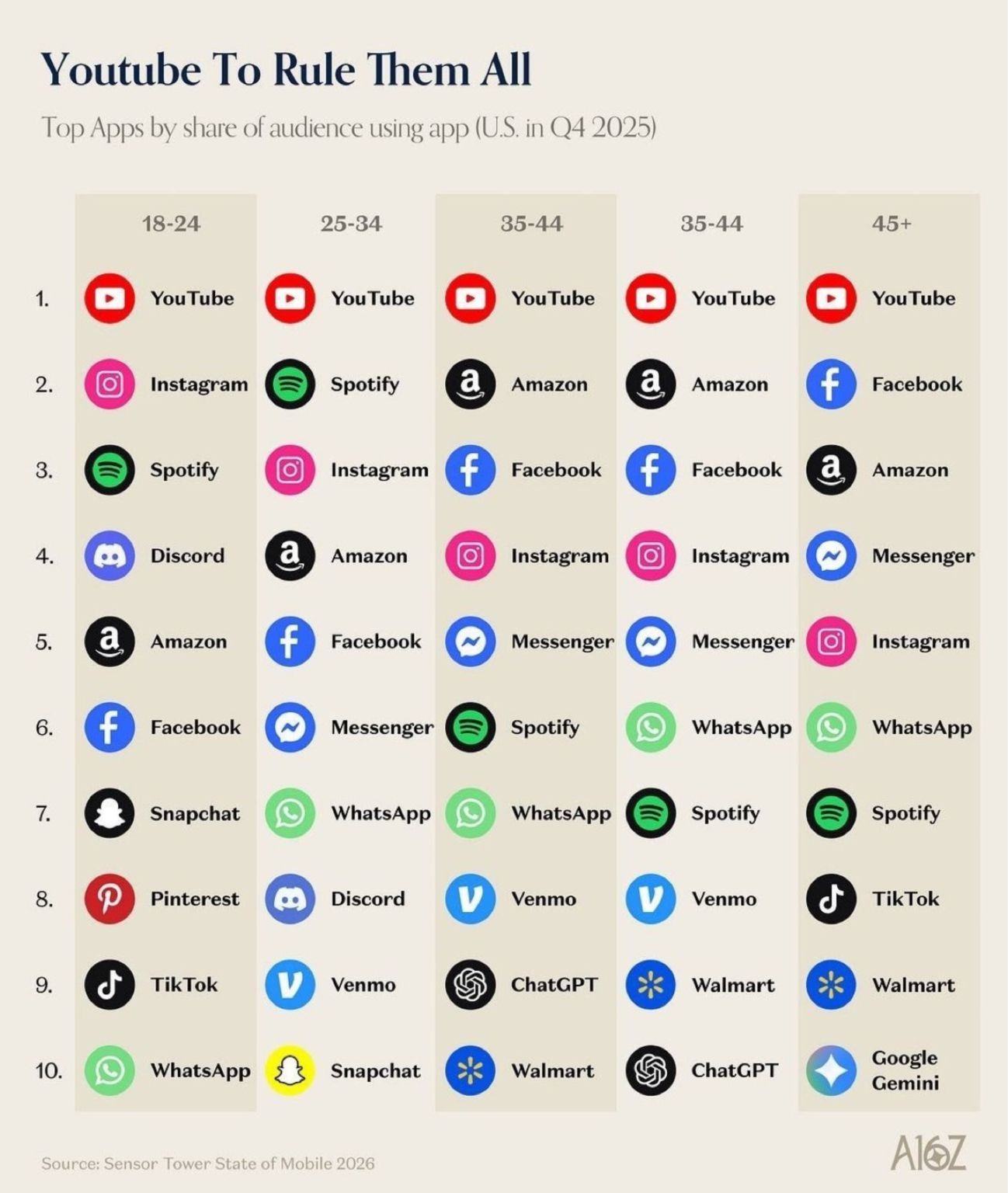
YouTube is now the number one platform across every single age group. Not just the 18–34s. Not just Gen Z. Every generation — from teenagers to retirees — is spending more time on YouTube than on any other platform.
This has never happened before. Not once in the history of digital media has a single platform unified every generation under one roof.
And yet, most brands are still treating it like a secondary channel. Something to "maybe look at next year." A nice-to-have that sits below paid ads, events, and whatever campaign the agency is pitching this quarter.
That's not just a missed opportunity. It's a strategic miscalculation that will be very difficult to recover from in three to five years' time.
The Data Is Telling You Something Most Brands Are Refusing to Hear
Here's the uncomfortable reality of modern media.
Every major social platform is fragmented by age. Instagram skews younger. Facebook skews older. TikTok is heavy on Gen Z. LinkedIn is a professional bubble. Even Snapchat has its lane.
YouTube doesn't have a lane. YouTube is the motorway.
It's the only platform in existence where a brand can run a single piece of content and reach a 16-year-old in Manchester, a 42-year-old in Edinburgh, and a 67-year-old in Bristol — all at once, all without paying a penny for distribution.
Top brand channels are now pulling more monthly views than traditional TV networks. The BBC — a 100-year-old institution — has 101 YouTube channels, 175 million subscribers, and 48 billion views. They announced they're creating content for YouTube first. Not for television. YouTube first.
Formula 1's YouTube channel now generates more views than their actual TV broadcasts. Their channel pulled 368 million views in a single three-month period. More people chose to watch highlights and behind-the-scenes content than tuned into the race live.
The Oscars will stream exclusively on YouTube in 2029. Think about that. An awards ceremony that has defined cinematic prestige for nearly a century — no longer on television. On YouTube.
This isn't a trend. Trends come and go. This is a structural shift in how human attention works.
Attention Is Power. YouTube Owns Attention.
There's a principle worth understanding before we go further: whoever controls attention controls distribution, and whoever controls distribution controls influence and revenue.
For decades, TV networks held this power. If you wanted to reach people at scale, you had to go through them. You had to buy airtime, negotiate slots, and hope your thirty-second ad landed before someone nipped to the kitchen to put the kettle on.
Brands didn't own their audience. They rented access to someone else's.
YouTube changed that equation entirely. For the first time, brands have direct access to distribution — without paying a gatekeeper. You build a channel, you build an audience, and that audience compounds over time. You post a video today that can still be getting ten thousand views in three years.
That's not how advertising works. That's how media empires work.
And a handful of brands have already figured this out.
The Brands That Get It Are Building Media Empires
Red Bull has a YouTube channel with 24 billion views. If they'd paid for that reach through traditional advertising, the cost would have exceeded half a billion pounds. Instead, they created content people actually wanted to watch — and built a billion-dollar media empire as a result.
They're not a drinks company with a YouTube channel anymore. They're a media company that also sells energy drinks.
The BBC's multi-channel strategy is another masterclass. They didn't pile everything into one giant flagship and hope the algorithm sorted it out. They built a network of focused channels — BBC News (19 million subscribers), BBC Earth (14.3 million subscribers), BBC Music — each built for a specific audience, each laser-focused on a distinct subject area. The master brand provides trust. The sub-channels provide relevance.
Red Bull followed an identical logic. Red Bull Motorsports, Red Bull Bike, Red Bull Snow — different verticals, same strategy. One brand, multiple communities.
What these organisations understood — and what most brands are still missing — is that YouTube isn't social media. It's the new television. The new search engine. The new education system. And unlike any of those things, it's free to distribute on.
The Big Mistake Most Brands Are Making Right Now
Here's what I see, again and again, when talking to marketing teams at serious companies.
They'll spend millions on paid ads without hesitation. Google, Meta, display, programmatic — the budget flows freely. But suggest investing in a YouTube strategy? Suddenly there are twelve questions about ROI, a need for "more data," and a request to revisit it in the next planning cycle.
The logic is backwards. Paid ads rent attention. The moment you stop paying, the views stop, the leads stop, the awareness stops. You're on a treadmill that gets more expensive every quarter and less effective every year.
YouTube builds owned attention. A video you post this month can bring in leads six months from now. A library of well-made content compounds in value over time, like interest in a savings account — except the returns keep growing and you don't have to keep depositing money to see them.
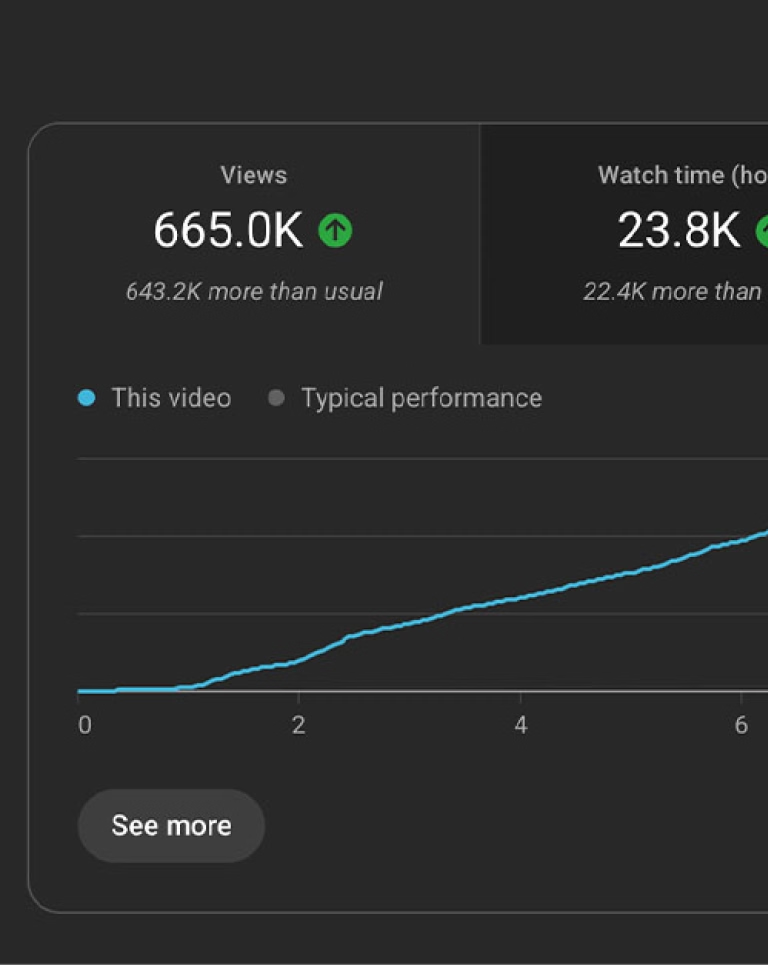
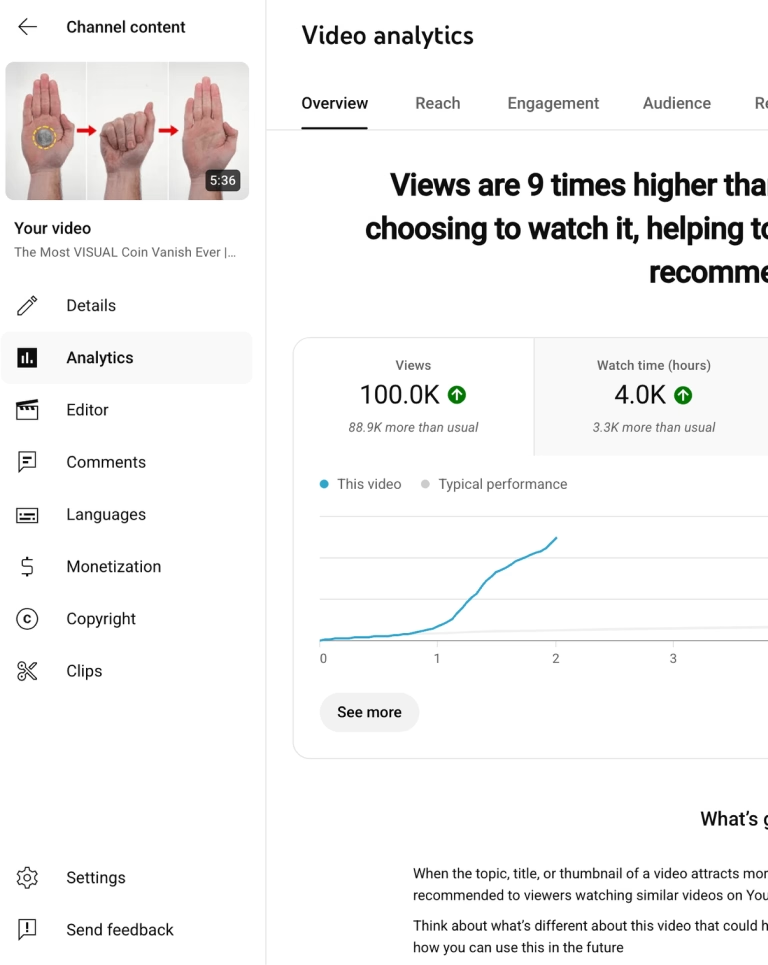
One of our clients got 200,000 views in sixteen days from a single video. The leads coming in from those views were warm — people who had already watched multiple videos, understood the brand, and arrived on sales calls practically ready to buy. The close rate nearly doubled. Compare that to paid ads, where it would have cost upwards of £12,000 to generate the same volume of views, and the leads would have been cold strangers who'd never encountered the brand before.
Organic YouTube doesn't just get you views. It builds trust, authority, and an audience of buyers.
The Opportunity Is Bigger Than You Think
Let me be direct about what this moment actually represents.
There is no other platform on earth where you can reach every generation — simultaneously, at scale, for free. That's not an exaggeration. That's just the current reality of digital media.
YouTube is long-form and short-form. It's search-driven and discovery-driven. It's entertainment and education. It's available in every country, on every device, at any time of day.
It is, to put it bluntly, a monopoly on attention.
And right now, most brands are leaving that monopoly entirely to their competitors.
The window to move won't stay open indefinitely. The brands that build now will have an audience in three years that is essentially impossible to replicate. You can't buy that kind of trust with an ad budget, no matter how large.
What Actually Needs to Change
This isn't about hiring a video team and posting more content. That approach fails more often than it succeeds because it misses the point entirely.
Winning on YouTube is a strategy problem before it's a production problem. It requires understanding what your audience actually wants to watch — not what you want to tell them. It requires curiosity-driven titles, high-retention storytelling, and consistent formats that can scale. It requires treating YouTube as a core channel, not a content dump.
The brands that are winning aren't just posting videos. They're building systems. Repeatable formats that can be produced at scale. Packaging frameworks designed to earn the click. Distribution strategies that compound over time.
Here's a simple way to think about it: every video should be a long-term digital asset working for your brand twenty-four hours a day, seven days a week. Not a campaign that runs for two weeks and dies. A permanent piece of content that brings in views, subscribers, and potential customers indefinitely.
That's a fundamentally different mindset to how most marketing departments currently operate — and it's exactly the shift that separates the brands that will dominate the next decade from the ones that won't.
The Prediction (And It's Not a Comfortable One)
The biggest brands in the world will become media companies. This isn't speculation — it's already happening. The question is simply whether your brand will be part of that shift or watching it from the sidelines.
YouTube will replace traditional television for most viewers within this decade. The infrastructure is already there. The audiences are already there. The content is already better. What remains is the lag between reality and how brands are allocating their budgets.
The brands that move seriously in the next twelve to twenty-four months will have an advantage that is genuinely difficult to close. Attention compounds. Authority compounds. Subscriber bases compound. Starting in 2027 isn't the same as starting today.
If You're Ready to Think Differently About YouTube
At Owen Creative, we work with serious brands that want to build YouTube into a predictable growth engine — not a channel that produces content and hopes for the best.
We've generated over 60 million views for clients. We've built systems for brands the size of BBC, Formula E, and UEFA. We've seen what happens when a brand commits to YouTube properly, and we've seen what happens when they don't.
If your brand is ready to stop renting attention and start owning it — let's talk.
Because the question isn't whether your brand should be on YouTube.
It's what's stopping you from starting today.



.png)

.jpg)