Making Money on YouTube Has Changed Forever. Here Is What You Need to Know.

Making Money on YouTube Has Changed Forever. Here Is What You Need to Know.
The way people have been making money on YouTube for the last decade is no longer working the way it used to. And if you are a business, a founder, or an expert who has been putting off building a YouTube presence, understanding this shift could be the most important thing you read today.
I have been posting on YouTube for over 10 years. My channel has grown to 1.5 million subscribers and over 350 million views. I have watched the platform change constantly. But nothing compares to what has happened in the last 12 to 18 months.
The rules have changed. And the brands and individuals who understand the new rules will have an enormous advantage.
The Old Way of Making Money on YouTube
For most of YouTube's history, the platform rewarded one thing above everything else: information.
If you knew something others did not, or you could explain it more clearly than anyone else, you had an edge. Maybe you understood productivity before everyone else. Maybe you cracked the code on marketing, weight loss, or building an online business.
The formula was simple:
- Explain a topic clearly
- Build an audience around that knowledge
- Launch a course or coaching programme
- Make money
And it worked. Entire online businesses were built on the back of this model.
But here is the uncomfortable truth. The edge was never YouTube itself. The edge was information scarcity. And that scarcity is gone.
Why Information Alone No Longer Cuts It
Today, if someone wants to know how to start a business, they do not sit down to watch a 25 minute YouTube video. They open ChatGPT. They ask a question. And within seconds they get a clean, structured, personalised answer.
No ads. No fluff. Just the answer they were looking for.
So if your entire value proposition on YouTube is "I explain things clearly," you are now competing directly with artificial intelligence. And that is a battle you will never win. AI is faster, more personalised, and infinitely scalable.
This does not mean the creator economy is dying. Far from it. It is expected to be worth over $450 billion by 2027. What is dying is generic, surface level information content. It is being replaced by something far more powerful.
The Trust Economy: What Is Actually Replacing It
The one thing AI will never be able to replicate is lived experience.
And that is exactly what people will pay serious money for.
Take my client Will Brown. He made $501,000 in a single month from his YouTube channel, averaging around 5,000 views per video. He actually broke it down in the video below:
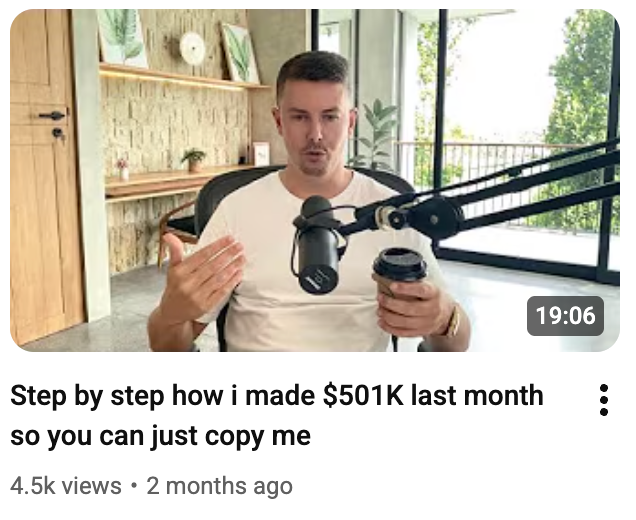
He teaches people how to build online coaching businesses.
Now, could you get that same information from ChatGPT?
Technically, yes. It would tell you to pick a niche, define your offer, build a funnel, run ads. All correct.
But what ChatGPT cannot tell you is what to do when your first ad campaign loses money for 10 days straight. It cannot walk you through your first nervous sales call. It cannot explain how to break through a revenue ceiling when you are stuck.
Those are not information gaps. They are experience gaps. And experience is what people actually pay for.
Information tells you what you can do. Experience tells you what you should do.
That is the difference. That is the shift. And if you are an expert in your field, this is genuinely good news.
The Three Step Trust System: How to Turn Credibility Into Sales on YouTube
So how do you actually apply this? Here is the exact framework I use with my clients.
Step 1: Frontload Your Credibility
Most people dive straight into the content of their video without giving viewers any reason to listen to them over a Google search or an AI tool.
You need to fix this. At the start of every video, in one or two sentences, establish who you are and what you have actually done. Not your job title. Not your qualifications. Your results.
Something like: I have helped 40 businesses grow on YouTube and this is what I have learned.
Simple, specific, and it gives the viewer a reason to keep watching. Because now they know they are not just watching someone explain theory. They are watching someone who has been in the trenches.
Step 2: Teach Through Real Examples, Not Theory
Every video you make from this point forward needs to reference a client result, a case study, or a mistake you personally made.
When you anchor your teaching in real world proof, you stop competing with AI on information and start building genuine credibility. Viewers begin to see you not just as someone who knows their subject, but as someone who has actually lived it. This is the foundation of trust. And trust is what drives sales.
Step 3: Be Consistent in Both Frequency and Focus
This is the step most people get wrong, and it is arguably the most important one.
The simple rule is: post one video per week for 52 weeks. But consistency is not just about how often you post. It is about what you post about.
If you jump between topics and shift your perspective video to video, your positioning becomes unclear. When people do not know what you stand for, trust disappears. Jaymin only makes videos about getting into Oxford and Cambridge maths. That singular focus is a huge part of why his audience trusts him and why they buy from him.
Before you post another video, write out what I call a channel vision statement:
I help [ideal viewer] go from [pain point] to [desired outcome] so they can [impact].
Every video you make should live inside that statement. If an idea does not fit, do not make it.
What This Means for Brands and Businesses
YouTube is not an advertising platform. It is a storytelling platform. And the brands that understand this distinction are building audiences that traditional media networks would genuinely envy.
Red Bull has 24 billion views on their channel. If they had paid for that reach through traditional advertising, it would have cost them over $500 million. Instead, they built a billion dollar media empire by creating content people actually choose to watch.
The BBC, Formula 1, and even the Oscars are all moving towards YouTube as their primary distribution channel. Not because they have to. Because that is where the audience is.
Top brand channels are now pulling more monthly views than TV networks. And unlike TV, they are reaching every generation in one place, without paying a penny for distribution.
The brands investing in YouTube strategy now will have a compounding advantage over the next three to five years. The brands that wait will find themselves competing for attention they can no longer afford to buy.
The Shift in Plain Terms
You are not competing on information anymore. Information is infinite.
You are competing on trust. And trust is scarce.
AI will keep getting better. It will write faster, edit faster, and publish faster than any human team. But it will never have your story. It will never have your mistakes. It will never have your results.
In a world where anyone can produce content, the only thing that genuinely stands out is credibility backed by proof.
So if you are a business leader, a founder, or an expert considering YouTube, ask yourself one question before every video you make: how do I make myself more trustworthy?
Lead with credibility. Post consistently. Back everything with proof. You will not just survive the AI wave. You will benefit from it.



.png)



.jpg)