How We Took a Brand from 5K to 200K Views on YouTube (Case Study)


How We Took a Brand from 5K to 200K Views on YouTube (Case Study)
Let me tell you something that most YouTube agencies won't admit.
High production value does not guarantee views. A polished video with cinematic camera work, professional colour grading, and a £10,000 production budget can still get 300 views. And a scrappy, creator-led video with the right title and thumbnail can pull 200,000.
I know this because we lived it. This is the story of how we helped a global football organisation do exactly that — and why the shift that made it happen matters for every brand sitting on an underperforming YouTube channel right now.
The Problem: Great Content That Nobody Was Watching
When we started working with this brand, their YouTube channel wasn't failing because the videos were bad. The production was solid. The access was world-class. The subject matter — professional football — has an enormous global audience.
But their videos were averaging 2,000 to 3,000 views each. For a brand of this size, that's not underperformance. That's a strategic misalignment.
The content felt corporate. Informational rather than irresistible. Built for brand messaging rather than audience curiosity. It was content that answered the question 'what do we want to say?' instead of the only question that actually matters on YouTube: 'why would someone click this?'
That's the trap most brands fall into. They optimise for brand consistency and sign-off approval, when they should be optimising for clicks and retention. The result is a library of high-quality content that the algorithm ignores — because the audience already has.
The Strategic Shift: From Production-First to YouTube-First
The core change wasn't about production. It was about thinking.
Most brands approach YouTube backwards. They start with: 'What video do we want to make?' Then they write a script, brief a production team, and work backwards to a title and thumbnail at the end. An afterthought. A label on a box.
We flipped it entirely.
Idea first. Title second. Thumbnail third. Production last.
That's not just a workflow preference — it's a fundamentally different philosophy. When you lead with the idea and the packaging, every creative decision that follows is in service of performance. When you lead with production, everything that follows is in service of the video you've already made.
For a brand operating in football, where traditional match content dominates, the challenge was to build something that could reach beyond the core fanbase. Something that felt like a YouTube video — not a brand asset.
The Framework: Core, Casual, and New
One of the strategic tools we rely on at Owen Creative is what we call the Core / Casual / New framework. Every piece of content we develop needs to speak to three distinct audience layers:
- Core — the existing, loyal fanbase who already know and love the brand.
- Casual — the broader audience who might be interested if the packaging earns their attention.
- New — a niche or adjacent audience who wouldn't normally encounter the brand at all.
Most brand content only speaks to the first group. It assumes prior knowledge, prior interest, and prior loyalty. That's why it plateaus.
The most powerful YouTube videos reach all three simultaneously — and that starts with the concept.
The Idea That Changed Everything
The video concept we developed was deceptively simple:
"I Tried Football's HARDEST Job for 24hrs (Sports Photographer)"
Let's break down why this works — because every word is doing something. First I’ll show you an infographic, then we will go into more detail:
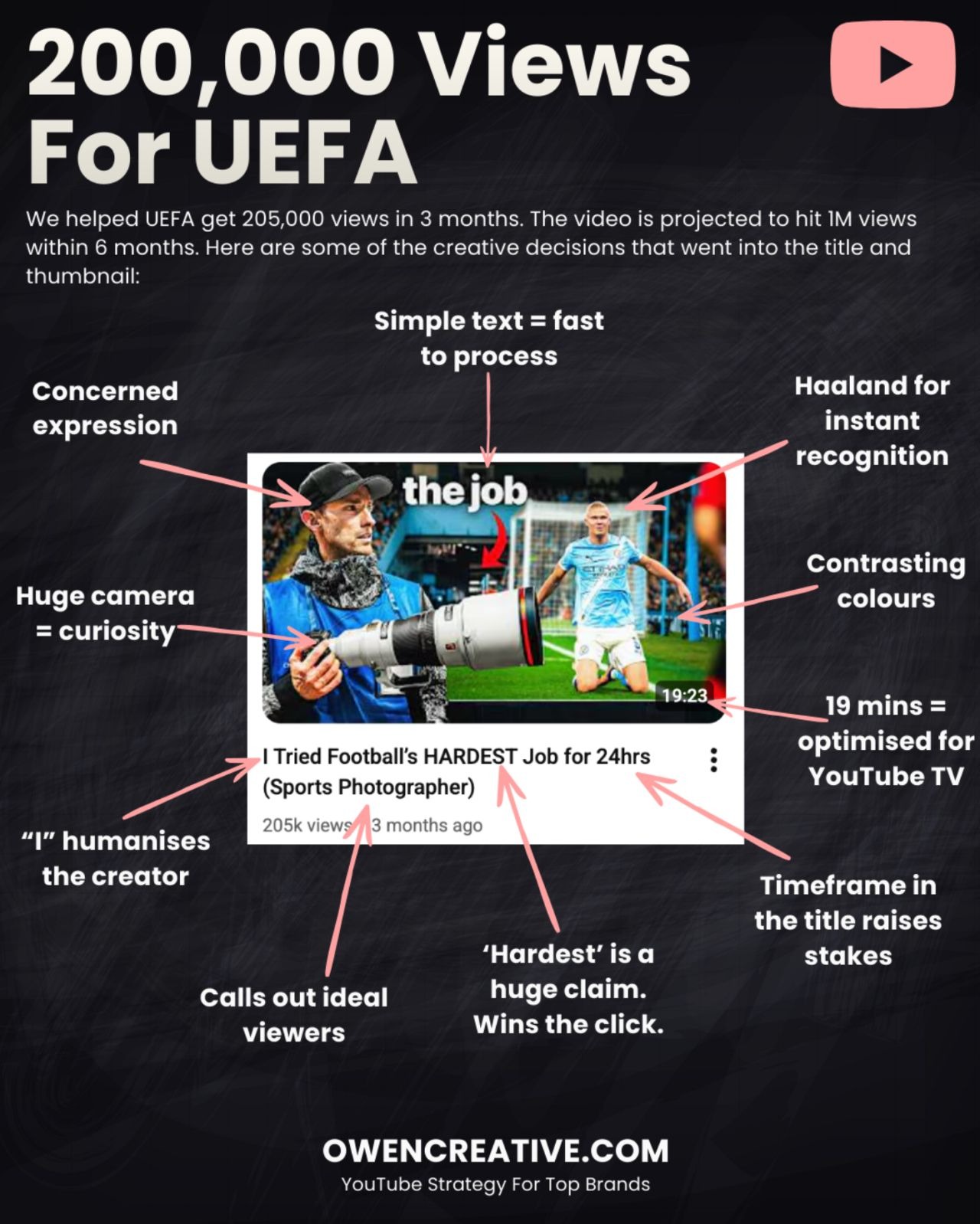
The 'I' is crucial. It's personal. It positions the video as a human experience, not a brand production. It signals creator content, which is exactly what YouTube's algorithm — and its audience — rewards.
'HARDEST Job' creates immediate tension. There's a challenge. There's a claim that needs to be proven. The viewer's brain wants to find out whether it's true.
'24hrs' adds a time constraint. Stakes. A beginning and an end. Structure that naturally drives watch time.
And 'Sports Photographer' is the niche hook — a specific angle that opens the video up to an entirely different audience beyond football fans. Photography enthusiasts, creators, behind-the-scenes obsessives. All pulled in through one targeted phrase.
That's the Core / Casual / New framework in action. Football fans watch for the access. General viewers watch for the human challenge. Photography fans watch for the craft. One concept, three audience layers.
Why the Thumbnail Matters More Than You Think
The thumbnail is not a design exercise. It's a conversion mechanism.
On YouTube, your thumbnail is competing for attention in a feed alongside hundreds of other videos. It has less than a second to communicate something compelling. If it doesn't win that micro-moment, the rest of the video is irrelevant.
For this video, the thumbnail was built around four principles:
- Emotion — a concerned facial expression that creates instant empathy and curiosity.
- Visual hook — an oversized camera lens that immediately signals the photography angle.
- Recognition — a well-known football figure (Erling Haaland) to anchor it in the football world.
- Simplicity — minimal text that can be processed at a glance, even on a small mobile screen.
The guiding principle we use at Owen Creative is this: if your thumbnail can't be understood in under one second, it's not doing its job.
Most brand thumbnails are beautiful. They look great in a pitch deck. They'd sit perfectly in an annual report. But on YouTube? They fail the one-second test every single time.
The Results: 200,000+ Views in 90 Days
Here's what happened when we put the strategy into practice.
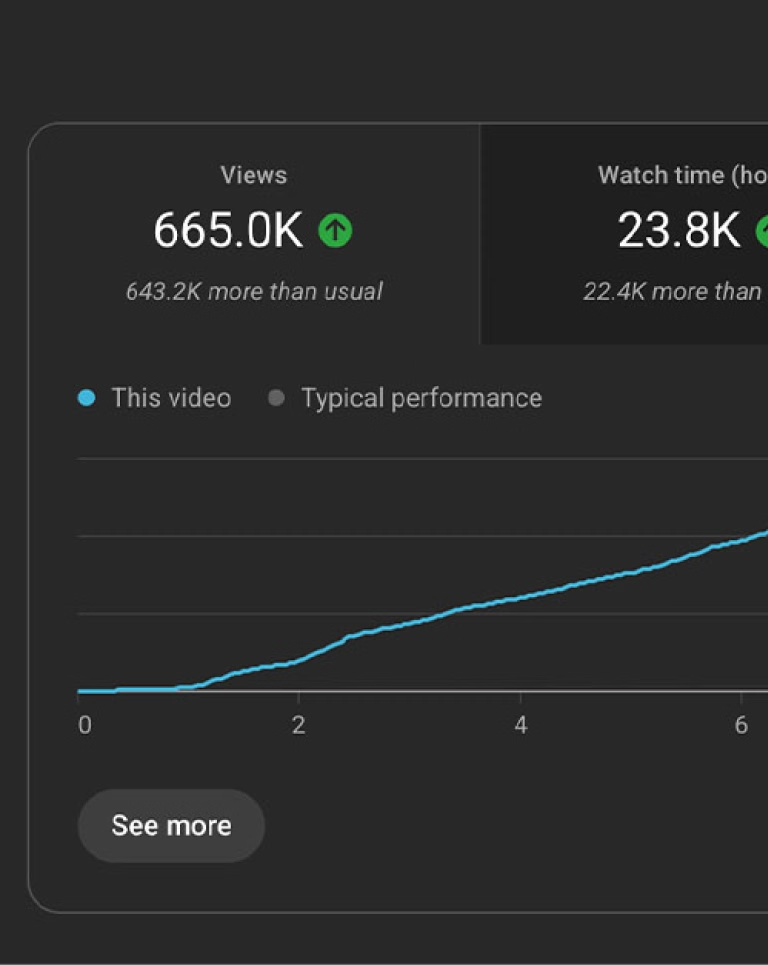
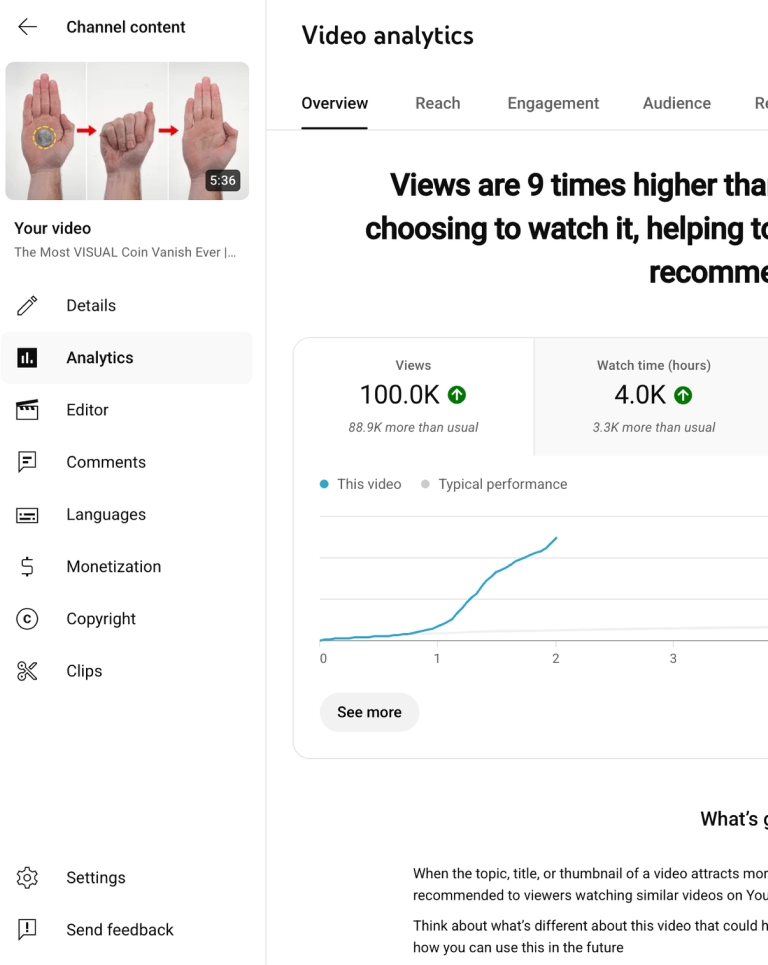
The video went from a baseline of 2,000 to 3,000 views per video to over 200,000 views in its first 90 days. That's roughly a 100x increase in performance. Not from a bigger budget. Not from a better camera. From a better idea, packaged for the platform it was published on.
Based on current trajectory, the video is projected to reach over 1 million views within six months of publishing — continuing to accumulate views long after posting because the algorithm is actively distributing it to new audiences.
That's the compounding nature of YouTube that makes it fundamentally different from every other platform. On Instagram or LinkedIn, your content has a shelf life of 24 to 48 hours. On YouTube, a video that performs well keeps working. It becomes a digital asset — not a post that disappears.
What Most Brands Get Wrong (And Why It's Not Their Fault)
I want to be direct about something here, because I think it's important.
The brands that struggle on YouTube aren't struggling because they're lazy or incompetent. They're struggling because the mental model they're using for YouTube is borrowed from advertising — and advertising thinking doesn't work on this platform.
In advertising, you control the message. You control the placement. You pay for reach. You interrupt an audience and deliver your content whether they asked for it or not.
YouTube is the opposite. Your audience chooses to watch. They click because they want to, not because you paid to put it in front of them. And if the first few seconds don't justify that click? They leave.
The brands winning on YouTube — Red Bull, BBC, Formula 1 — aren't winning because they have bigger budgets. They're winning because they think like media companies, not advertisers. They ask: 'Why would someone choose to watch this?' And they don't move forward until they have a compelling answer.
That's the shift we help brands make at Owen Creative. It's not complicated. But it does require letting go of the instinct to lead with brand messaging — and trusting that if you build content people actually want to watch, the brand benefits will follow.
The System Behind the Success
I want to be clear about something: this wasn't a one-off. It wasn't luck, and it wasn't a fluke.
The results came from a repeatable system — and that's what we build for every brand we work with. Not individual videos. Systems.
The Owen Framework is built on four stages: Observe, Why, Execute, and Nurture. We start by studying the audience, the platform, and what's already working. We define exactly who the content is for and why they'd watch. We build the formats, scripts, titles, and thumbnails that are designed to perform. And then we convert that attention into something valuable — subscribers, community, revenue.
Every stage is systematic. Every decision is performance-led. And the system is designed to compound over time, not produce a single spike that disappears.
That's the difference between a YouTube campaign and a YouTube strategy.
The Broader Point: Brands Must Think Like Creators
There's a shift happening in media right now that I think about a lot.
For decades, brands bought attention. They paid for TV slots, magazine pages, banner ads. They rented space in someone else's audience. And for a while, that worked.
But rented attention is getting more expensive and less effective every year. Ad-blockers. Subscription platforms. Shorter attention spans. The cost of interrupting someone has gone up dramatically — and the returns have collapsed.
The brands that will win the next decade aren't the ones with the biggest ad budgets. They're the ones building audiences of their own. On YouTube, in particular, that means making content people genuinely choose to watch.
Red Bull figured this out years ago. They didn't just sponsor extreme sports — they built a media empire around it. Their YouTube channel has accumulated over 24 billion views. If they'd bought that reach through traditional advertising, it would have cost them over £500 million. Instead, they created it through content.
That's the model. And it's available to any brand willing to think differently about YouTube.
Final Thought
If your brand is investing in YouTube and not seeing the results you expected, the problem probably isn't your production quality or your posting frequency. It's your strategy.
The question to ask isn't 'how do we make better videos?' It's 'why would someone click this — and why would they keep watching?'
Answer those two questions correctly, and everything else falls into place.
If you want to understand what that looks like for your brand specifically, we offer YouTube strategy audits — a focused session where we look at your current channel, your audience, and the gap between where you are and where you could be.
Start there. The views will follow.



.png)


.jpg)